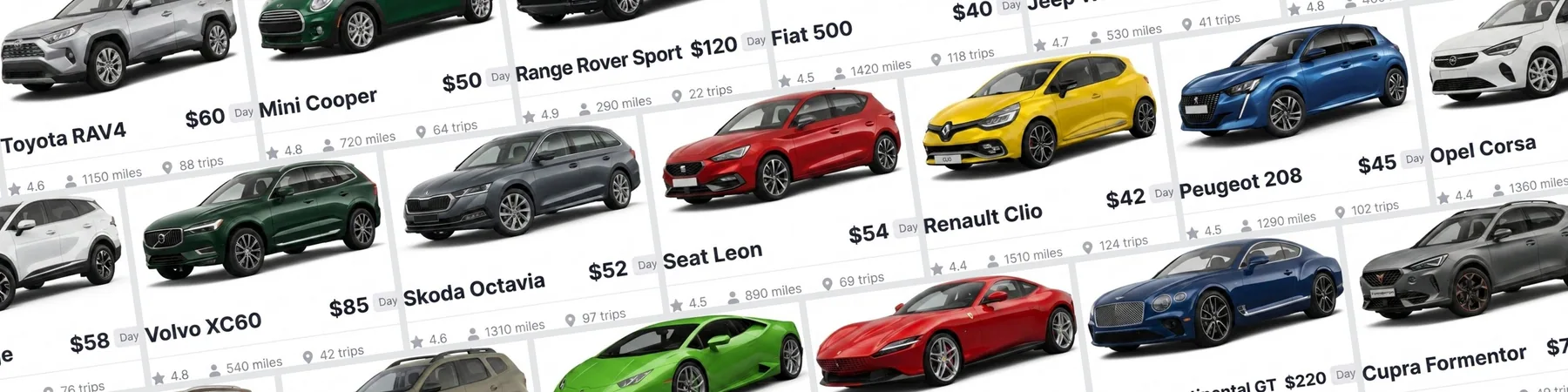
Campaigns need the right car in the right colour at the right resolution, usually by Thursday. A rendered catalogue turns those requests from production projects into request parameters, with usage rights that survive legal review.

The campaign needs the hatchback in red for social, the estate in grey for print, and both transparent for the landing page. That is not three briefs to a studio, it is three URLs.
The workflow marketing actually runs, minus the waiting.
Model, trim and colour from the brief resolve to the exact car, no VIN required.
Eight exteriors plus interior, transparent, shadowed or grounded, per placement.
Each channel gets its size and format from the same source, so social, display and print match.
The colour change that used to kill a deadline is a new URL, and the old asset stays reproducible forever.
The same catalogue serving social, display, print and landing pages.



Half of automotive marketing runs on press photos with editorial licences and crossed fingers. Rendered imagery has one rights holder and a commercial licence written for campaigns, which ends the quiet risk under every launch.
Landing pages outlive their shoots, and the facelift makes last year's hero image quietly wrong. Resolved imagery updates with the catalogue, so evergreen pages stay correct without anyone remembering to check.
The colour variant that used to cost us a week of back and forth is now a parameter. Our launch pages went out with every colour the market sells, on time.
Yes, that is what the transparent cutouts are for. Consistent framing and lighting make the compositing repeatable, so one scene template serves the whole range.
Resolution is a request parameter, so print sizes come from the same catalogue as web assets. Ask for the dimensions your print spec needs.
The licence is written to cover the campaign, including agency production and client publication. One agreement instead of a rights chase per asset.
Every factory colour renders on demand, which is usually the first thing teams try, because press kits ship three colours and markets sell fourteen.
Vehicles render from specification data once it is in the catalogue, which typically beats press photo availability. For embargoed launches, check timing with us directly.
It complements it. Hero brand shoots stay for the emotional layer, and the catalogue covers the long tail of variants, formats and channels no shoot budget reaches.
Marketing teams do not lack vehicle images. They lack the right variant of the right vehicle at the right moment: the colour the market actually sells, the angle the layout needs, the resolution print demands, cleared for the channel in question. The gap between the press kit and the brief is where campaign timelines quietly die.
A campaign is rarely one image. It is a matrix of models, colours, angles, formats and channels, and every cell of that matrix used to be a small production task. With a rendered catalogue the matrix collapses into parameters: the estate in grey, transparent, at print resolution is one request, and the twelve social variants are twelve more. The creative team spends its time on the idea instead of the inventory.
Emotion. The sunset drive, the lifestyle scene, the launch film: that remains photography and film. The catalogue takes everything else, which in a real campaign is most of the asset list, and frees the shoot budget to do the work only a shoot can do.
The unglamorous win is legal. Press photos carry editorial licences, stock libraries carry exclusions, and both get used commercially anyway under deadline pressure. A catalogue with one rights holder and a campaign ready licence turns image clearance from a recurring risk into a signed document. Launches stop carrying a quiet asterisk.
Tell us the models, colours and channels in your current campaign. You get the variants back with the licence text your legal team wants to read.