












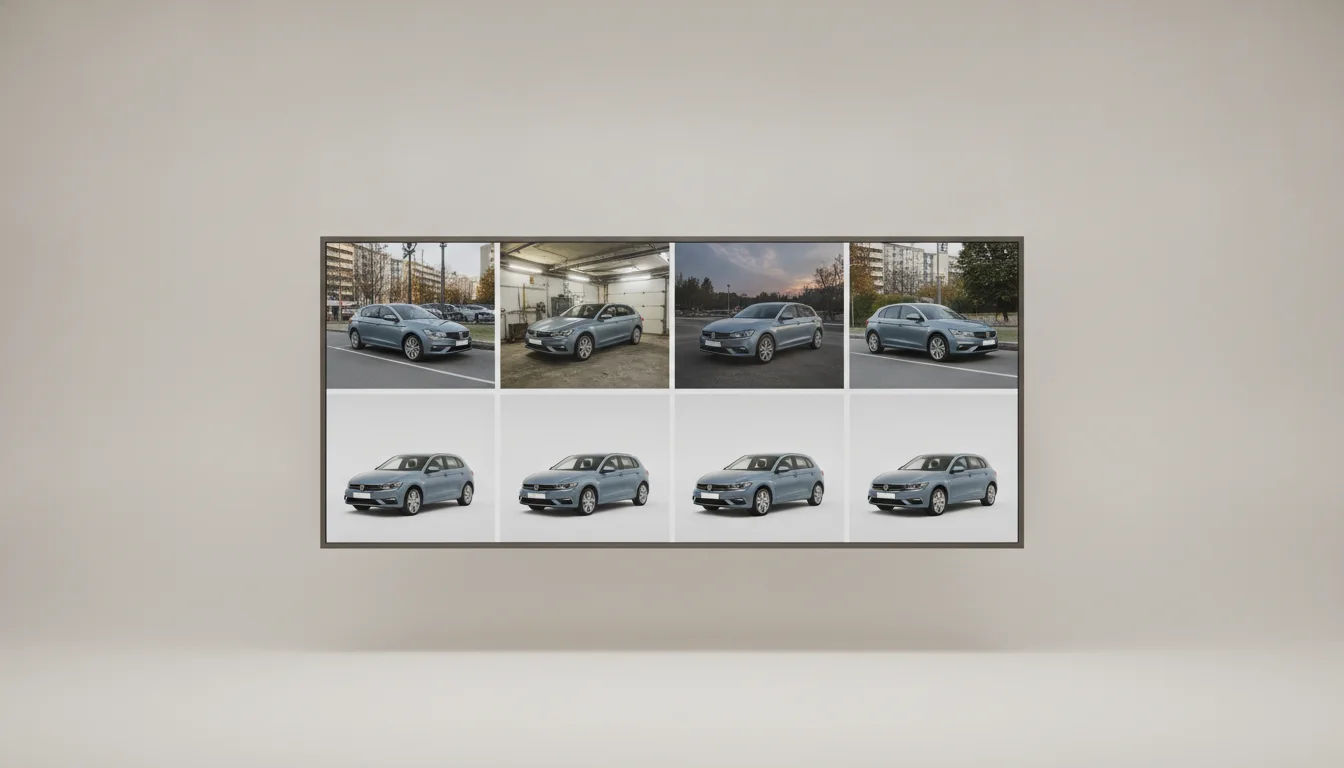
Scroll any large car marketplace and you can reconstruct the supply chain from the pictures alone: a dealer forecourt in the rain, a manufacturer press shot, a phone photo with a thumb in the corner, a competitor's watermark. Every listing was uploaded in good faith, and the page as a whole looks like a flea market. Image quality issues in car listings are rarely about resolution. They are about inconsistency, and inconsistency is structural.
The seven classic failures
- Mixed sources: photos, press kits and screenshots side by side in one search result
- Mixed backgrounds: forecourt, street, showroom and living-room driveway in one grid
- Missing angles: three photos of one car, eleven of the next, none of the interior
- Wrong car: a lookalike press photo standing in for the actual trim
- Watermarks and dealer branding baked into the pixels
- Stretched, cropped or letterboxed images fighting the layout
- Stale images: last year's facelift illustrating this year's model
Individually each is cosmetic. Together they read as an untrustworthy page, and buyers transfer that judgement from the pictures to the platform.
Level 1: rules for sellers
Photo guidelines covering minimum resolution, angle checklists and background requirements are where every marketplace starts. They help, and they cap out quickly. You are asking thousands of independent sellers to run a photo studio to your standard; the ones who could are not the ones who need the guideline. Enforcement becomes a moderation queue, and the queue becomes a backlog.
Level 2: cleaning up what arrives
Background removal, auto-cropping and relighting tools patch individual photos. They fix the background problem and none of the others: the angles are still missing, the car is still sometimes the wrong one, and a cleaned-up phone photo is still visibly a phone photo next to a studio image. Useful as a polish, structurally insufficient.
Level 3: standardise the source
The structural fix is to stop depending on what sellers upload for the parts of the page that need to be uniform. A rendered catalogue serves every vehicle in the same framing, the same lighting and the same background, resolved from the listing's own data: make, model, year, trim and colour. Seller photos then do what only they can do: show condition. The two layers answer different questions, and pages that separate them look deliberate instead of collected.

The long tail is where this pays off hardest: the eight-year-old hatchback nobody photographs professionally gets the same studio treatment as the new flagship. How that works at marketplace scale is on vehicle images for marketplaces; the accuracy half of the problem (right trim, right wheels, right colour) is covered in trim and colour accuracy.
A checklist for your own audit
- Pick 50 random listings and count how many distinct visual styles appear
- Count listings whose first image is not the vehicle's front three-quarter view
- Count listings where the pictured trim differs from the listed trim, starting with the wheels
- Measure search-to-listing click-through for consistent vs inconsistent result pages, if your analytics allow it
If the audit hurts, the problem is structural, and rules for sellers will not fix a structural problem.